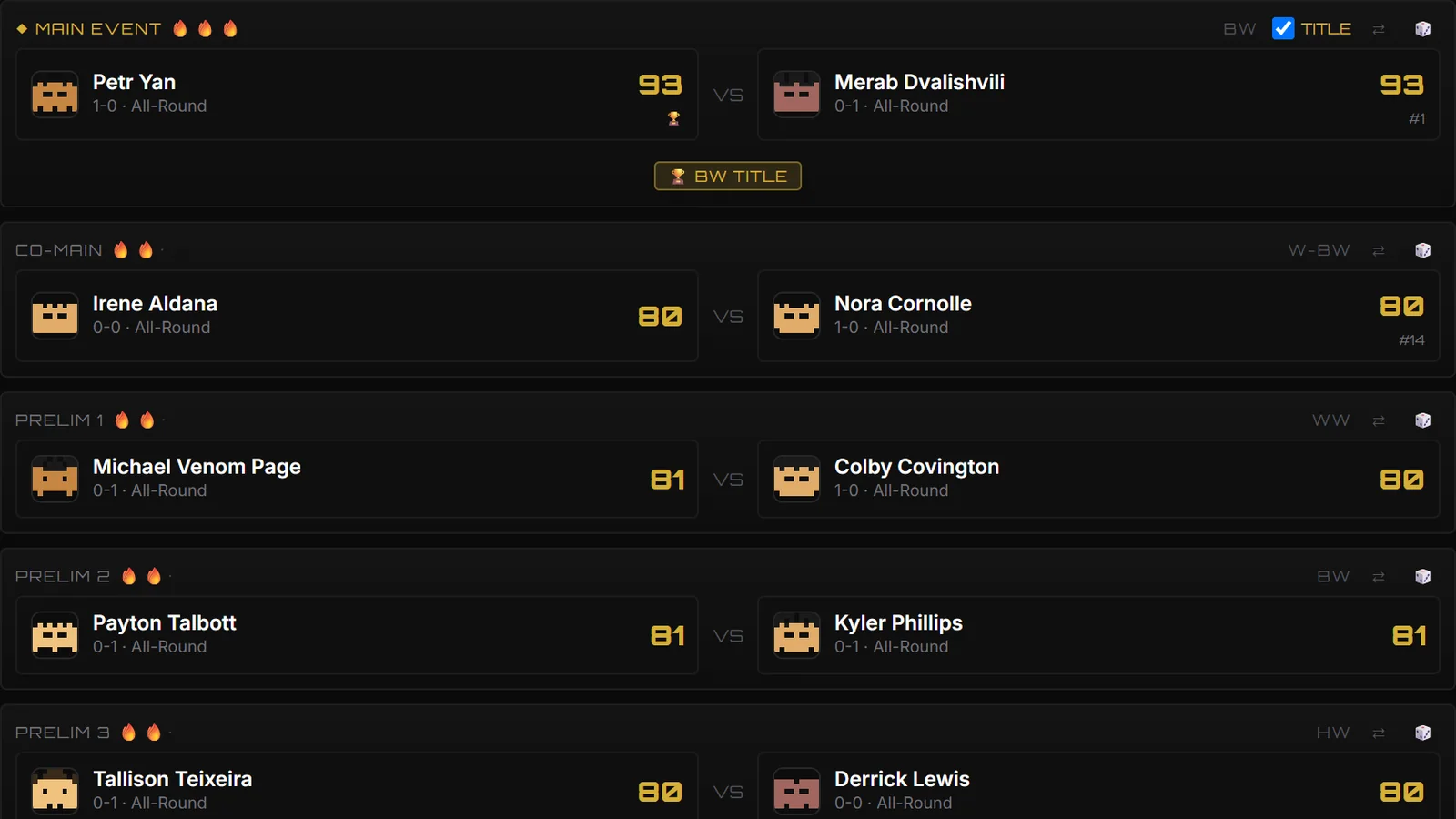
Somebody emailed us last week about our booking game. He had found a way to book a women’s strawweight against the heavyweight champion — for the heavyweight title.
He was right, it was embarrassing, and it took an afternoon to fix. What took longer was the third thing in his email, which turned out to be sitting on top of something much worse.
The report that led somewhere else
His third point was about retired legends. In MMA Manager Simulator you can pay a large fee to bring a retired great back for a three-fight farewell run. He pointed out that if one of them wins a belt and then retires again, the fans keep asking for a rematch that can never be booked.
True, and worse than he knew: the champion could never defend either, so that division was frozen for the rest of the career. A retired champion now hands the belt back and the top two contenders fight for the vacant title.
But while we were in there, a question came up that nobody had thought to ask. How often does a belt change hands in this game?
Zero
We ran twelve promoter careers of thirty events each. Every card built with the Auto button, every venue upgrade taken as soon as it was affordable, all the way up to Global Tour with tens of millions in the bank. Three hundred and sixty fight cards.
Not one of them had a belt on the line. Not one champion was dethroned. Across the whole experiment, at every scale, the number of title fights was zero.
Which is absurd, because the game is built around the belt. It crowns eleven champions on the day you start. The rankings move after every fight and feed contenders upward. And the “Fans want to see” panel — the thing that tells you what your audience is asking for — was serving three title shots, every single event, for thirty events, and none of them ever made it onto a card.
The champion is the most expensive man on the card
The cause is a single loop at the end of the auto-booker, and once you see it the whole thing is almost funny.
Auto builds a card in priority order: a signed legend headlines, then one fight the fans have demanded, then a title fight if the division has an obvious one, then the rest of the card gets filled to budget. Sensible. Then, at the very end, one last pass checks whether the purses actually fit what the building can gross. If they do not, it finds the most expensive bout on the card and swaps it for the two cheapest available fighters in that division. It repeats until the card fits.
A champion earns a purse bonus. A returning legend earns a much bigger one. A fight the fans have been screaming for is, almost by definition, between two people who are expensive.
So “replace the most expensive bout” and “delete the reason anybody bought a ticket” were the same instruction. The trim went straight for the main event every time, because the main event is always the priciest thing on the card. Then it replaced it with two of the cheapest men in the division, marked the bout as not-a-title-fight, and moved on satisfied that the budget was balanced.
The legend was worse off still. A farewell run costs between $350,000 and $1.35 million to sign, the dashboard promises the legend will headline your cards, and he was cut from all forty of the auto-booked cards we tested. The game placed him in the main event correctly, and then the budget pass removed him a few lines later, and the pool it drew replacements from excludes legends, so he did not reappear anywhere on the card.
Why nobody noticed for months
Because that trim only ever ran inside the Auto button.
If you book a card by hand, picking each fighter yourself, nothing touches it. Tick the title box and the belt is on the line and stays there. Our own promoter diary was played that way, by hand, over 24 events — and crowned thirteen champions. From the inside, the game looked fine.
The players it actually hit were the ones doing what the tutorial tells them to do. The first line of the day-one guide says to fill the card and hit Auto if you are unsure. Follow that advice and you would run a promotion for a year of in-game time and never once put a title on the line, while a panel on the same screen told you every fortnight that the fans wanted exactly that.

Nine events into a run on the fixed build: two champions with a defence to their name, and a light heavyweight belt that has already changed hands.
What changed
The marquee bout is now off limits to the budget pass. A title fight, a signed legend, or the fight the fans asked for cannot be trimmed. Prelims get cut instead, down to a floor of four bouts, and below that the card is simply allowed to run over — which is a decision you can see on the projection bar rather than one the game quietly makes for you. Overspending on a title fight is a choice a promoter should get to make.
Measured again, the same way, twelve careers of thirty events with Auto every time:
- First title fight: event one, where it used to be never.
- First new champion crowned: event three.
- Across thirty events: 8.9 title fights and 4.2 belts changing hands, against zero and zero.
Two smaller things fell out of the same investigation. The demands panel was showing three title shots every time, because champion-versus-number-one outranks everything else in all eleven divisions, which meant contender fights and win streaks never got a look in; it now shows one belt at a time and the rest of the division’s stories underneath. And the champions strip on your dashboard, which for months was just the eleven names the game started with, now tracks defences and marks a division whose belt is vacant.
The part that is actually true of the sport
There is a version of this problem that is not a bug at all.
The fight everyone wants to see is the most expensive fight to make. That is not a quirk of our code; it is the central tension of running a promotion. Champions cost champion money, the names that sell tickets know what they are worth, and a matchmaker with a fixed budget and a card to fill faces a genuine choice between the fight that pays and the fight that matters.
What our booker was doing was resolving that tension automatically, in the same direction, every single time, and never telling anybody. The budget always balanced. The card was always affordable. And the thing the budget existed to pay for was the first thing out the door.
It is a decent lesson in what optimisation does when you point it at the wrong number. The rule was working perfectly. It was just working on cost, when what the promotion was actually short of was a reason for anyone to watch.
The fix is live. If you had a promotion running, your save carries over — and if one of your divisions has been frozen behind a retired champion, it will unfreeze the next time you load it.