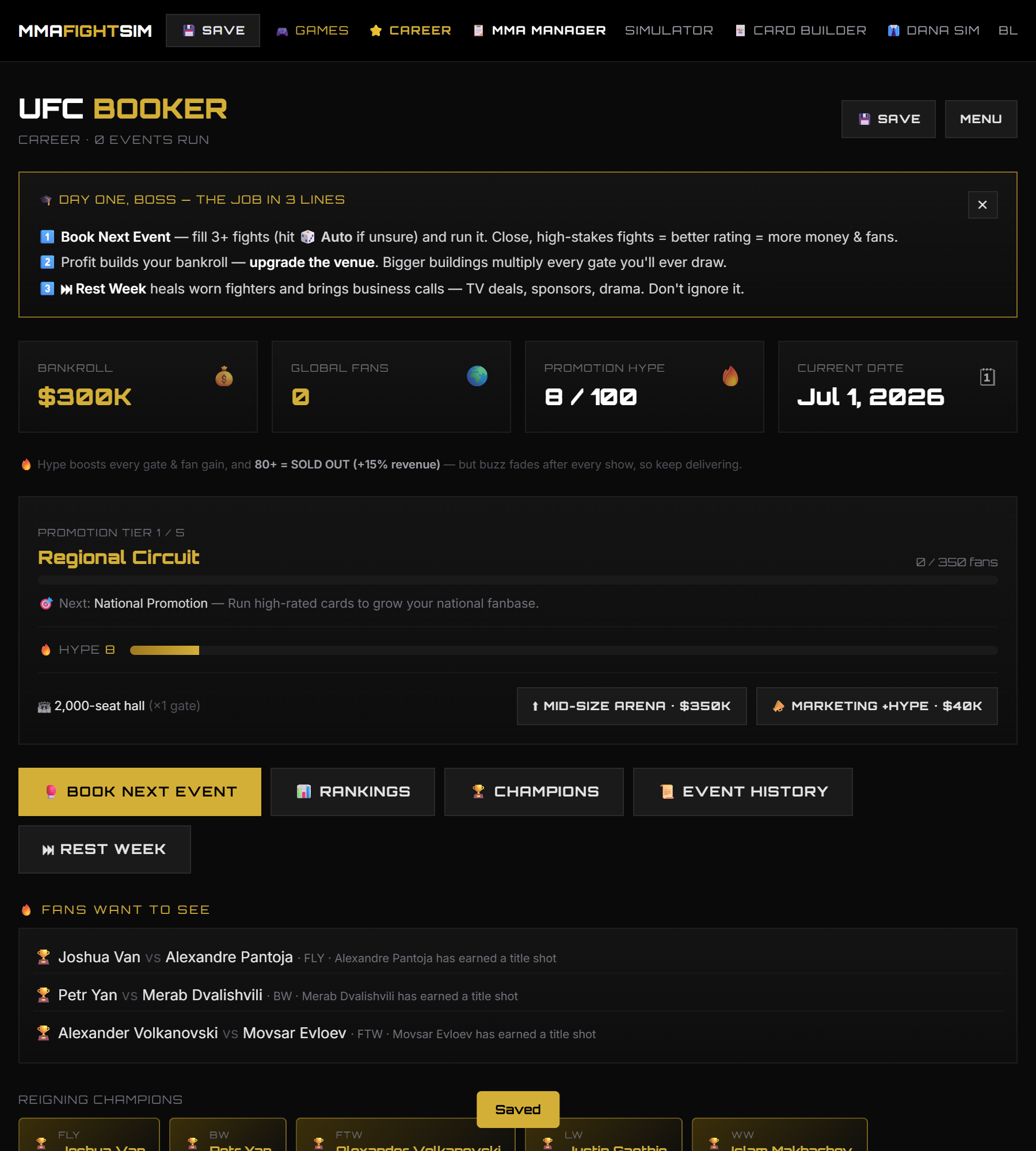
The game hands you three things on day one: a bankroll of $300,000, a hall that fits two thousand people, and a roster of 300+ real fighters who all cost real money to book. What it doesn't hand you is any guarantee those three things are compatible. My plan was simple: book good fights, grow the fanbase, move into a bigger building, and get out before the investors got nervous.
It nearly worked in the opposite order.
Months 1 to 3: everything loses money and that's normal
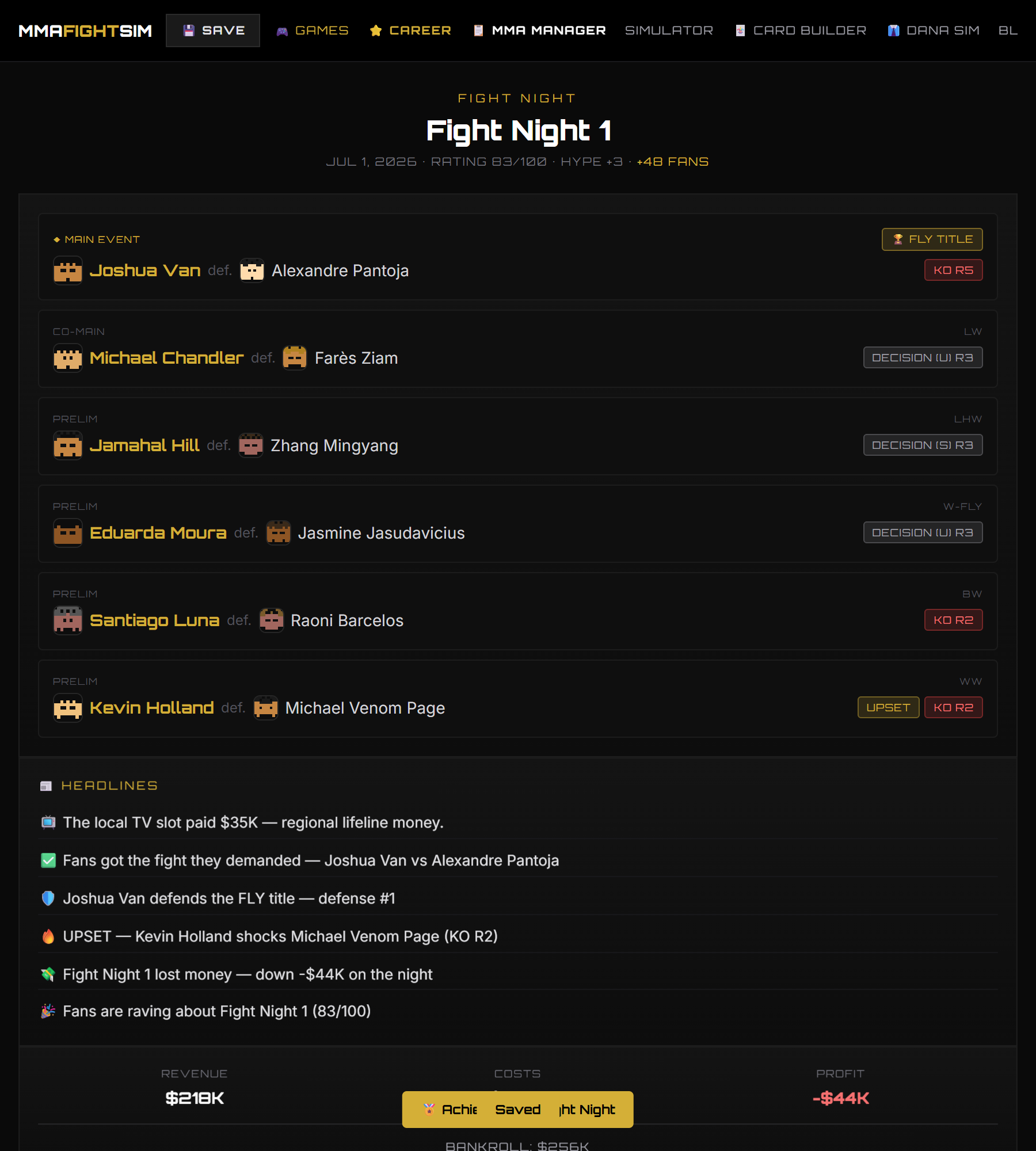
My first card, Fight Night 1, was headlined by Joshua Van submitting Alexandre Pantoja in the third round. The crowd loved it. The card rated 82 out of 100. It lost $23,000.
Fight Night 2 rated 79 and lost $49K. Fight Night 3 rated 80 and lost $11K. This is the first hard lesson of the game, and I suspect it filters out a lot of new promoters: at the local-gym level, a good Fight Night is a loss leader. The gate is capped by the size of the building, and ranked fighters do not fight for regional money. The thing keeping the lights on was a $35K local TV slot that lands every event while you're small. It's described in the news feed as "regional lifeline money", which is exactly what it is.
Then came the fourth event, my first pay-per-view. Ilia Topuria knocked out Justin Gaethje in round three, the card rated 86, and the night made +$101K. In one evening the PPV earned back everything the three Fight Nights had lost. That's the actual economic loop of the early game: survive three cheap shows, cash the PPV, repeat.
Months 4 to 8: rest weeks are secretly the business
Between shows you can hit Rest Week, and I'd been ignoring it, because resting felt like not playing. Mistake. Rest weeks are where the phone rings. A city offered a site fee to take an event on the road. A sponsor put money on the table. A fighter named Sam Hughes failed a drug test and I had to choose between suspending her publicly or quietly burying it. I suspended her; the fans respected it and the hype went up.
Not every call is free money. When Alex Pereira got hurt in training, I paid $40K for elite rehab to get him back in three weeks instead of nine. That week's card lost $73K as a direct result. I'd still make the same call: a healthy Pereira sells more tickets than the $40K ever would.
By event six the fanbase crossed 350 and the promotion ticked up to National Promotion. The tier system is the real progression track in this game. Money comes and goes, but fans only accumulate.
Month 9: the upgrade that nearly ended everything
After UFC 303 cleared +$138K, I was sitting on $411K and feeling wealthy. The Mid-Size Arena costs $350K and multiplies every future gate by 1.35. I bought it immediately.
The next card lost $86K, because my payroll had quietly scaled up with the promotion while the new building hadn't paid for itself yet. Bankroll: $55K. One more bad night and I'd have been staring at the game's bankruptcy warning, where the investors give you three deep-red events before pulling out. I have never booked more carefully in my life.
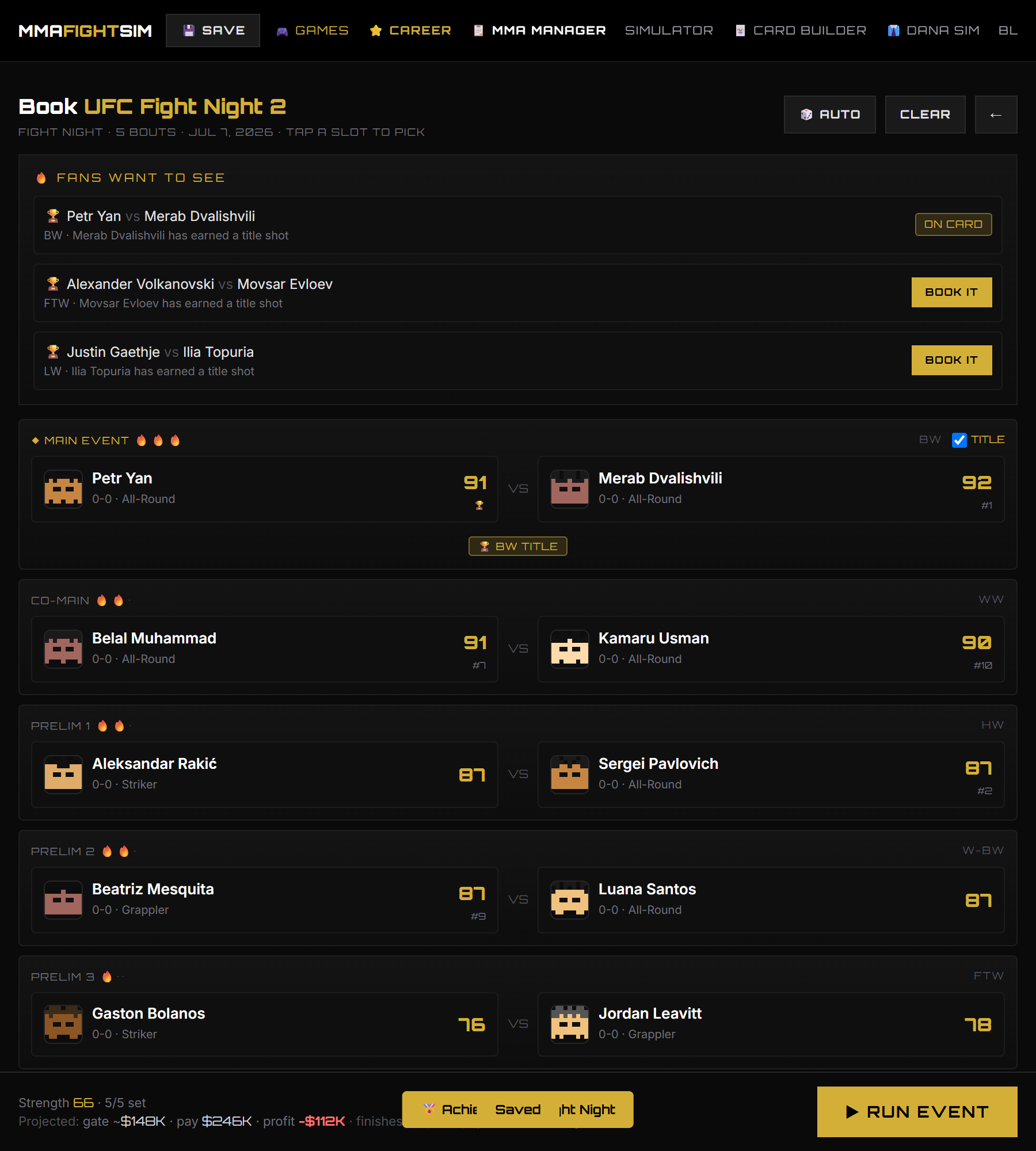
What saved the run was the Fans Want To See panel. The game tracks specific matchups your audience is demanding, and booking them adds a bonus to the gate. For the next five events I basically let the fans book the cards. Merab Dvalishvili vs Petr Yan. Pantoja vs Van. Movsar Evloev vs Alexander Volkanovski. Every one of those pairs fought multiple times across my run, and every rematch someone demanded outdrew the fight I would have picked myself.
Months 10 to 18: rivalries print money
Three series carried the whole second half of the promotion, and none of them were planned:
- Topuria vs Gaethje went four fights. Topuria KO'd him at UFC 301, Gaethje answered with a fourth-round knockout, then Topuria took the next two by submission. 3-1 in the series, and the two biggest gates I ever drew.
- Dvalishvili vs Yan went five. Merab won the first three, then Yan won two straight, the last by split decision. The fans demanded almost every installment.
- Evloev vs Volkanovski also went five, trading the featherweight title back and forth. Their UFC 306 meeting closed out my career with a +$356K night.
Islam Makhachev dethroning Carlos Prates at UFC 304 was the single "NEW CHAMPION" headline that turned my welterweight division into appointment viewing. In total, thirteen new champions were crowned on my cards. The rankings in this game genuinely move, and when a belt changes hands the next title fight is worth more.
UFC 305 was the peak: a site fee, a demanded main event, and a +$503K profit on one night. Eight months earlier I'd been counting a $55K bankroll.
The exit
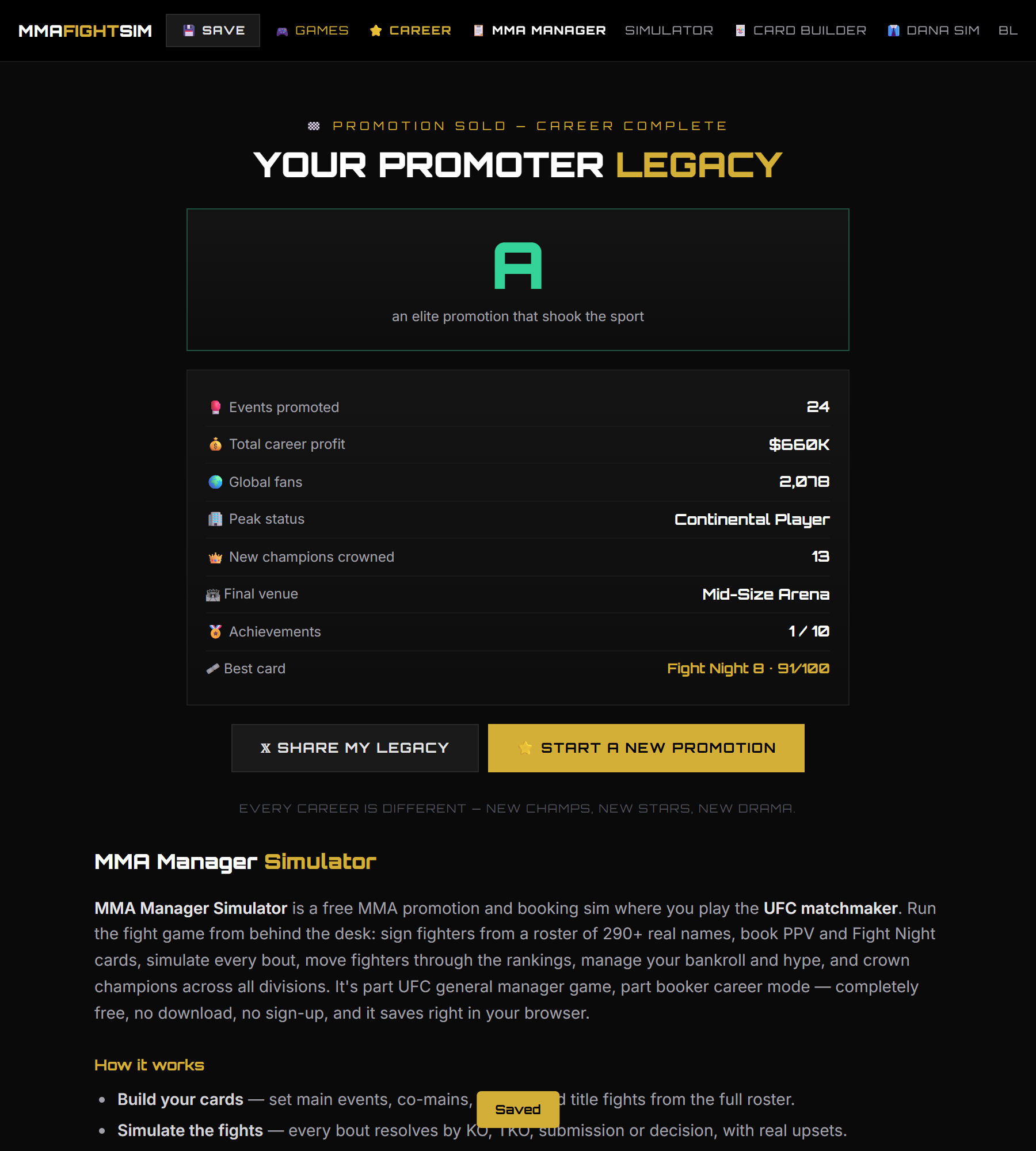
At 24 events I sold the promotion. Final ledger: $660K total career profit, 2,078 global fans, Continental Player status, 13 champions crowned, best card rated 91. The game graded the whole run an A: "an elite promotion that shook the sport." I'll take it, mostly because for one week in month nine the grade was heading somewhere much worse.
What I'd tell a first-time promoter
- Expect Fight Nights to lose money early. That's the design, not a bug in your booking. The TV slot, rest-week calls and PPVs are your income until the building grows.
- Never skip Rest Week. Sponsors, TV deals and drama arrive between shows. Playing event-event-event is how you bleed out.
- Book what the fans demand. The demand panel adds real gate money, and demanded rematches build the rivalries that carry your career.
- Upgrade the venue with a cushion, not a balance. I bought at $411K and survived on $55K. Buy when the upgrade costs less than about 70% of your bankroll.
- Sell when the story's good. Bankruptcy ends the career at whatever your record shows. A voluntary exit locks in the grade you earned.
Every run generates different champions, different rivalries and different disasters, which is most of the reason I'm already three events into promotion number two.
Run your own promotion — free, in the browser, saves locally.
▶ Play MMA Manager SimulatorFAQ
Is MMA Manager Simulator free?
Yes. It runs at mmafightsim.com/booker/ in any browser, no download or signup. Careers save locally.
Can you actually go bankrupt?
Yes. Stay more than $300K in the red for three straight events and the investors pull out, ending the career with a final grade. You get a clear warning first.
What's the fastest way to make money early?
Cash the local TV slot every show, take rest-week sponsor calls, protect your PPV cadence, and book the fights the demand panel asks for.
How long is a career?
As long as you want. This one was 24 events in roughly 40 minutes. You can retire any time after a few events, or grind to #1 in the World.