First, what cauliflower ear actually is
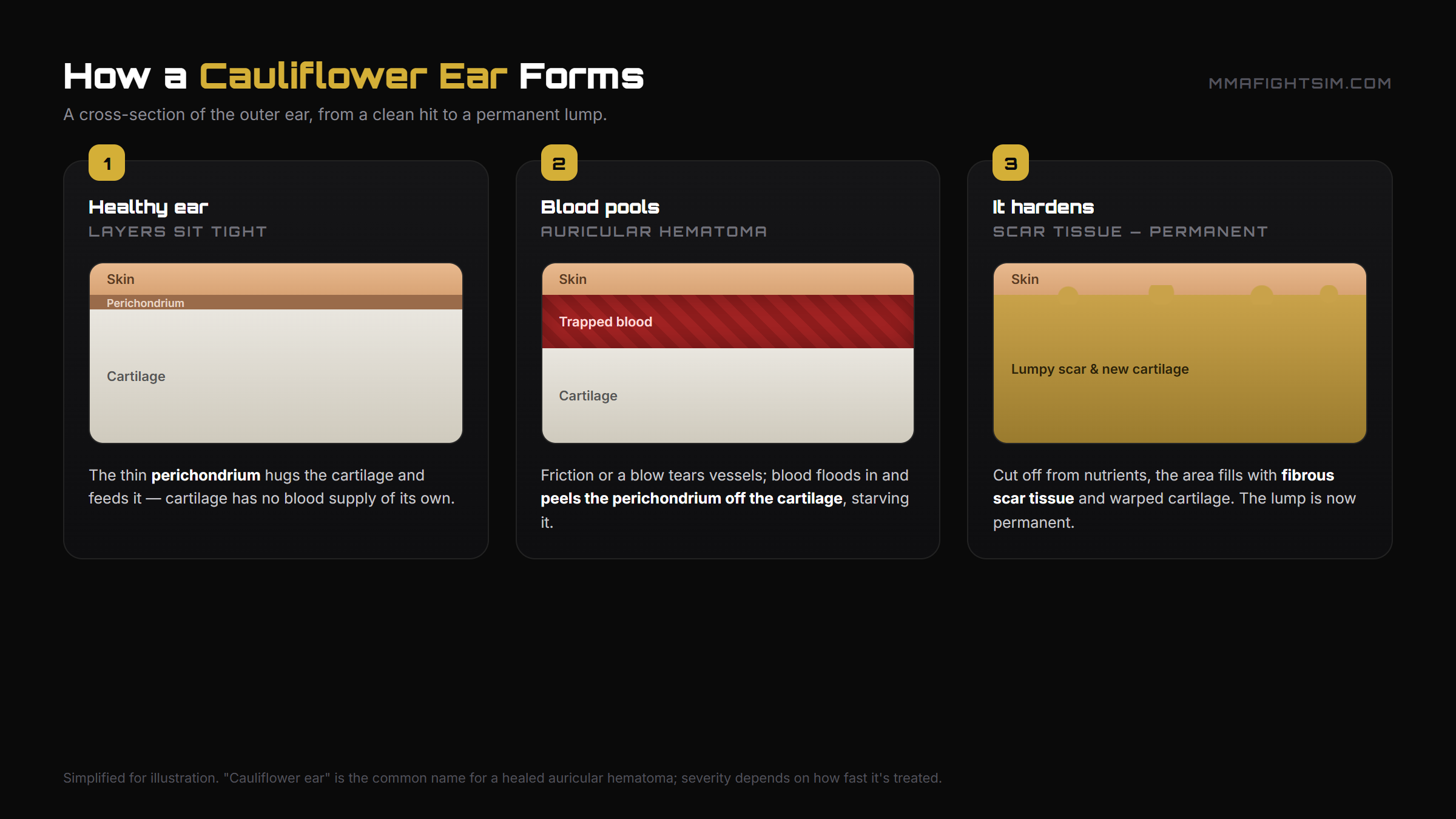
The medical name is an auricular hematoma, and it is exactly what it sounds like: a pocket of blood trapped inside the ear. To understand why it warps the ear so badly, you have to know how the ear is built. The outer ear is basically a thin layer of skin stretched over a sheet of cartilage, with a delicate membrane called the perichondrium sandwiched between them. That membrane matters more than it sounds, because ear cartilage has no blood supply of its own. It stays alive entirely on nutrients passed through the perichondrium pressed against it.
Now hit that ear, or grind it against a mat for three hard rounds. Small blood vessels tear, and blood floods into the gap between the perichondrium and the cartilage. The ear balloons up hot and tender, and the membrane gets peeled away from the very cartilage it was supposed to be feeding.
Why it doesn't just heal
Here is the cruel part. Cut off from its blood supply, the cartilage begins to starve. The body's repair job is not to rebuild the smooth original shape but to fill the gap with whatever it can, which means fibrous scar tissue and lumpy, disorganized new cartilage. That is the "cauliflower" texture: hard, irregular, and fused in place. Once that scar tissue sets, the ear is permanently reshaped, and no amount of rest brings the old contour back.
This is why timing is everything, and why you will hear grapplers casually talk about draining an ear the same week it puffs up.
Why grapplers get it and strikers mostly don't
Most people assume cauliflower ear comes from getting punched. It is really about friction and constant pressure, not clean strikes. Wrestlers, judoka and Brazilian jiu-jitsu players spend hours a day with an ear mashed into a mat, an opponent's hip, or the crook of an arm during a choke. That repeated grinding is a perfect slow-cooker for a hematoma. Pure strikers can develop it too, usually from clinch work or time on the ground, but the worst ears in the sport almost always belong to grappling specialists. Randy Couture, a decorated wrestler, is the textbook example. So is Khabib Nurmagomedov.
Can fighters actually avoid it?
They can, though it takes discipline that a lot of fighters never bother with. There are two real defenses, and they work at different stages.
The first is prevention, and it comes down to headgear. Those padded ear guards wrestlers wear in the practice room exist almost entirely to kill the friction that starts this whole process. The catch is that headgear is banned in actual competition, and plenty of fighters skip it in training because it is hot, muffles sound and gets in the way.
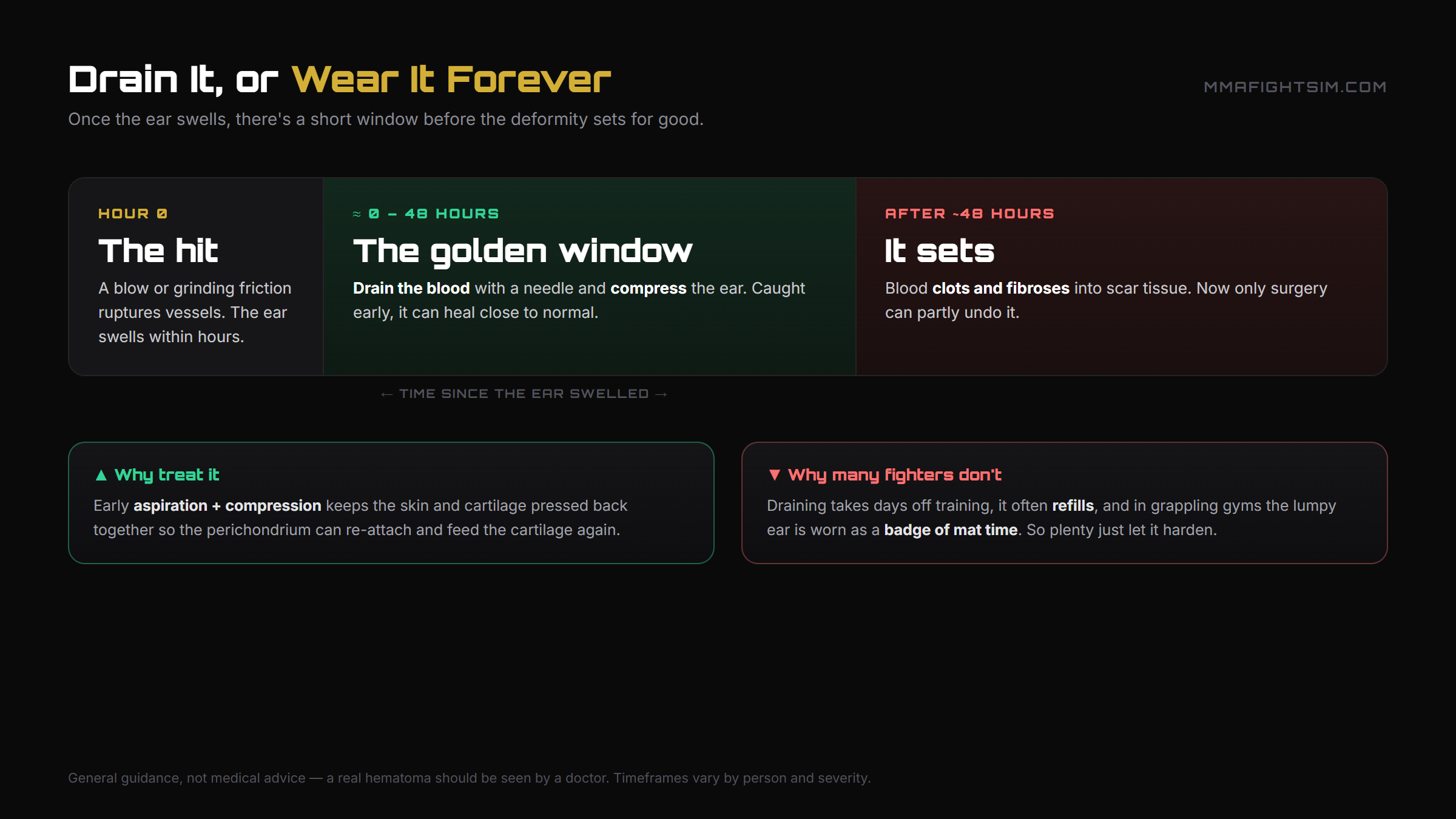
The second is fast treatment. If the ear does swell, there is a narrow window, often put at around 48 hours, to drain the trapped blood with a needle and then compress the ear firmly so the skin and cartilage press back together and the perichondrium can reconnect. Caught early, the ear can recover close to normal. Leave it, and the blood clots and fibroses, and from that point only a surgeon can partly undo it.
So why do so many fighters just let it happen?
The reasons are as much cultural as medical. Draining an ear properly means days away from grappling, and even then it often refills and has to be drained again, so it is a genuine nuisance in the middle of a camp. But the bigger reason is pride. In a lot of gyms a mangled ear is a badge, a visible sign that someone has logged serious mat time. Walk into a wrestling room or a jiu-jitsu academy and the lumpy ears are everywhere, worn almost like a uniform. For plenty of fighters, letting it set is a choice rather than an accident.
Does it affect hearing?
Usually not in the way people expect. The deformity sits on the outer ear, so a healed cauliflower ear by itself rarely changes how well someone hears. The exceptions are severe cases where swelling or scar tissue narrows the ear canal and muffles sound, and the fresh hematoma stage, which is genuinely painful until it is dealt with. The lasting issue is almost always cosmetic, not functional.
The most honest scar in the sport
Weight cuts happen behind closed doors and knockouts are over in a flash, but a cauliflower ear is a permanent receipt you carry for life. It is the sport written onto the body. If you want to understand the grinding grappling exchanges that cause it in the first place, our free fight simulator and career mode let you dig into how wrestling and ground control actually decide fights, the same relentless mat pressure that leaves its mark on every serious grappler's ears.
FAQ
What causes cauliflower ear?
A blow or repeated friction tears small vessels in the ear, and blood pools between the skin and cartilage. If that blood is not drained, it hardens into scar tissue and warped cartilage, which is the permanent lump.
Is cauliflower ear permanent?
Once the trapped blood fibroses into scar tissue, yes. Only surgery can partly correct it after that. Drained within roughly 48 hours, an ear can heal close to normal.
How do you fix or prevent it?
Prevent it with padded headgear that cuts the friction. Treat a fresh swelling with needle drainage plus compression. For a set cauliflower ear, a surgical procedure called otoplasty is the only real option.
Does it hurt or affect hearing?
The fresh hematoma is swollen and tender. The healed lump usually does not affect hearing unless it is severe enough to narrow the ear canal.