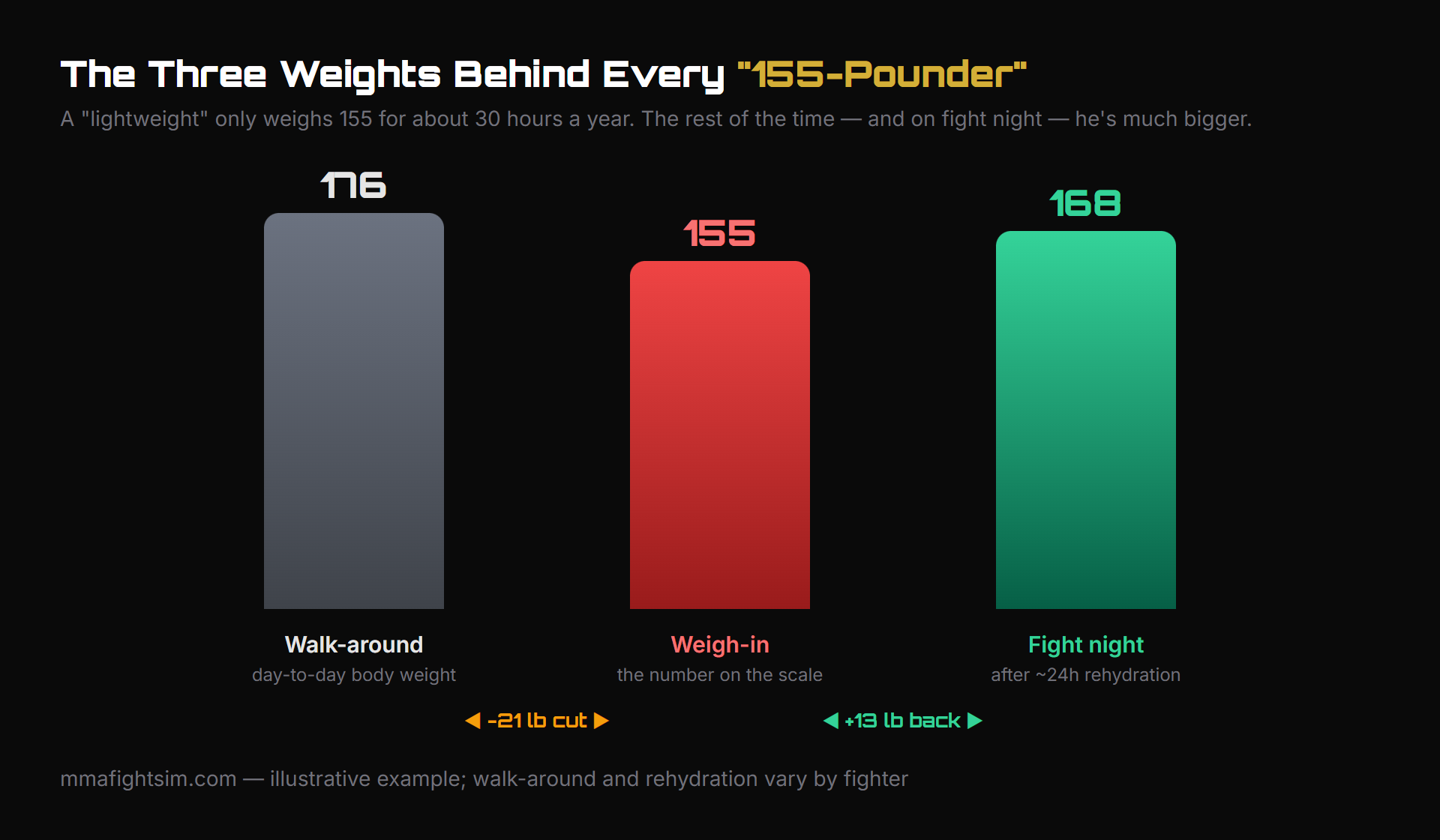
The single most misunderstood thing in MMA is what a division name means. When someone says a fighter is a lightweight, casual fans picture a person who weighs 155 pounds. The reality: that fighter probably walks around at 175, drops to 155 for one terrifying morning, and steps into the cage the next night closer to 168.
Making weight is not dieting. It is a controlled, deliberate dehydration, and understanding it changes how you watch every fight.
Walk-around weight vs. the limit
Every fighter has a walk-around weight: what they actually weigh living their normal life, training hard, eating enough to fuel it. That number is almost always well above their division's limit. The division limit is just the ceiling they have to touch, once, at the official weigh-in.
So the game every fighter plays is: how far below my natural weight can I safely drop, so that on fight night, after I put the weight back, I'm the bigger, stronger person in the cage? That question is why weight cutting exists, and why it keeps getting more extreme.
The fight-week water cut, step by step
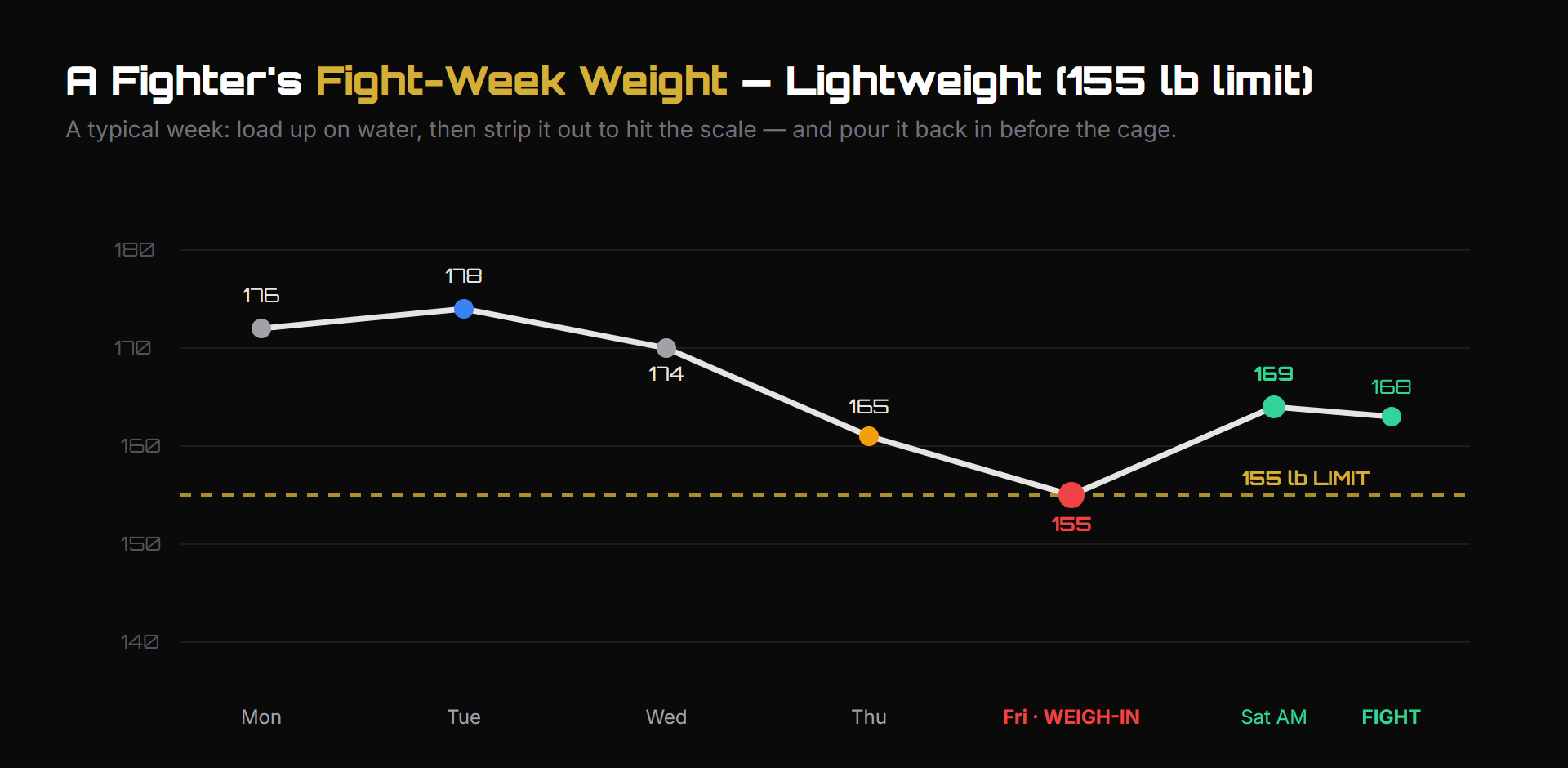
Fat loss happens over the full training camp: eight to ten weeks of dialing in nutrition to arrive at fight week a few pounds above the limit. The dramatic part, the 15-to-20-pound swing everyone talks about, happens in the final days and it is almost entirely water. A rough map of a hard week:
- Early week — water load. The fighter drinks a lot, sometimes two gallons a day. Flooding the body with water tricks it into flushing water out aggressively, so that when they cut the intake later, the body keeps dumping.
- Mid week — deplete. Sodium and carbohydrates get stripped out. Both make the body hold water, so removing them sheds several pounds on their own. Water intake starts dropping.
- Final 24-48 hours — dehydrate. This is the ugly part. Hot baths, saunas, and training in plastic sweat suits pull the last several pounds out as sweat. A fighter can lose 6 to 10 pounds of pure water here, and by the end they feel genuinely terrible.
- Weigh-in. They hit the number, step off the scale, and the recovery begins immediately.
- Rehydrate and refuel. Over the next day they carefully drink and eat the weight back (water, electrolytes and carbs), climbing 10 to 20 pounds before the opening bell.
Why it's the most dangerous part of the sport
People assume the danger in MMA is the punches. Coaches will tell you the scariest part of fight week is often the scale. Severe, rapid dehydration is hard on the body in ways a clean knockout is not:
- It thickens the blood and forces the heart and kidneys to work under strain.
- It thins the cerebrospinal fluid that cushions the brain, which may make a dehydrated fighter more vulnerable to a knockout. A grim irony, since the cut is done to gain a size edge.
- Done wrong, it can kill. Multiple fighters around the world have died from complications of extreme cuts, which is exactly why regulators got involved.
The UFC responded with two big changes: moving official weigh-ins to the morning (giving fighters a full extra day to rehydrate instead of cutting late into the night) and banning IV rehydration, forcing recovery to happen the slower, safer, oral way. Neither ends weight cutting; they just put guard rails on it.
What happens when a fighter misses weight
Sometimes the cut fails. The fighter can't get the last pound or two off, or the doctor stops them for safety. Missing weight has real consequences:
- They forfeit money. Typically 20 to 30 percent of their purse goes to the opponent who made weight.
- They can't win the belt. If it's a title fight, only the fighter who made weight is eligible to become or stay champion, even if the one who missed wins the fight.
- The bout may change or vanish. It can proceed as a catchweight if the opponent agrees, or get scrapped entirely.
- Reputation damage. Chronic missers get a label, and matchmakers and opponents remember it.
See the gaps for yourself
Once you know a division name is a ceiling, not a description, the whole roster reads differently. Two fighters in the same weight class can have completely different real sizes depending on how far each one cuts. Our UFC weight class calculator lets you enter any weight in pounds, kilograms or stone and see exactly which division it lands in and how far it sits from the limits, the same math a fighter's coach runs on fight week. If you want the full breakdown of the divisions themselves, start with UFC weight classes explained.
And because cutting changes who is actually bigger on the night, it quietly shapes matchups. In our fight simulator you can pit fighters across divisions and see how a size gap tilts the odds, the same edge a fighter is chasing every time he steps on that scale.
Which weight class are you? Check any weight in lbs, kg or stone. Free.
⚖️ Open the Weight Class CalculatorFAQ
How much weight do UFC fighters cut?
Usually 15 to 20 lbs in the final week, sometimes 25 to 30 for big-framed fighters, and nearly all of it is water. They weigh in at the limit, then rehydrate 10 to 20 lbs before the fight.
Is it fat loss or water?
The camp-long part is fat and conditioning. The dramatic fight-week swing is almost purely water, which is why it comes off fast and goes back on fast.
Why did the UFC move weigh-ins to the morning?
To give fighters a full extra day to rehydrate after making weight, reducing the danger of extreme late cuts. IVs were also banned, forcing slower oral recovery.
What's a catchweight?
A fight contracted at a non-standard limit, often used when a fighter can't make the division weight. No title can be won at a catchweight. More in our weight class calculator.