The official answer is shorter than you think
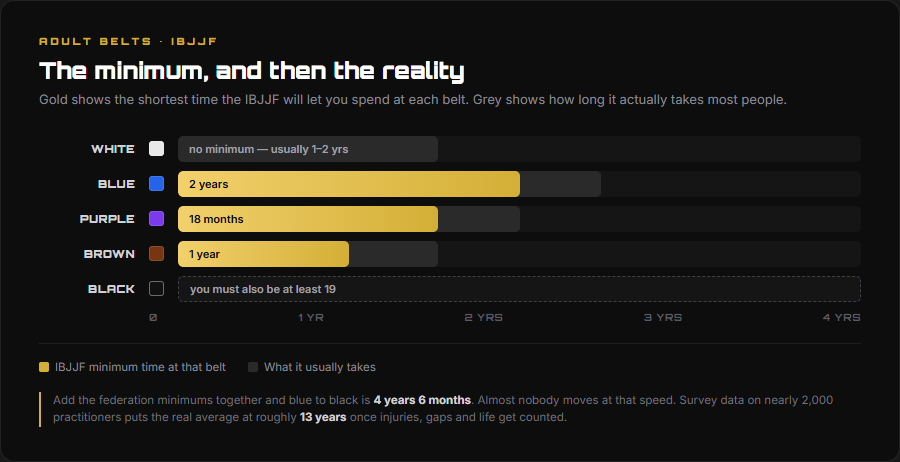
The IBJJF, which is the closest thing jiu-jitsu has to a governing body, publishes minimum times you must spend at each adult belt before you can be promoted. They are not long:
- Blue belt: at least 2 years before purple
- Purple belt: at least 18 months before brown
- Brown belt: at least 1 year before black
- Black belt: you must also be at least 19 years old
White belt has no stated minimum at all. So on paper, from the day you tie on a blue belt, the fastest legal route to black is four and a half years. Add a year or two at white and you land somewhere near six.
Now go and ask a room full of black belts how long it took them. You will hear ten, twelve, fifteen. A survey of nearly two thousand practitioners put the real average at roughly thirteen years. That is not a rounding error. That is the federation minimum, doubled, and then some.
Where the other eight years go
Not to training, mostly. That is the part people get wrong when they do the maths and conclude they will be a black belt by 2032.
The minimums assume something nobody actually does: an unbroken decade of consistent training with no interruptions. Real timelines get eaten by things that have nothing to do with talent. A knee that needs eight months. A job that moves you to a city with no good gym. A kid. A gym that closes. The eighteen-month stretch where you were technically a member but went twice.
Then there is the fact that the minimums are minimums. A coach is under no obligation to promote you the day you become eligible, and most do not. The belt is their signature, not a certificate you earn by attendance, and in jiu-jitsu specifically that signature is unusually personal, there is no written exam, no points system, no central board. One person decides, based on watching you roll for years.
The blue belt is the one that filters everybody. Estimates for how many white belts ever reach it vary wildly, but every coach will tell you the same thing: the room empties long before the belt colour changes.
What a black belt actually certifies
Here is the thing that surprises people coming from other martial arts, where a black belt often means "has completed the syllabus." In BJJ there is no syllabus to complete. What the belt certifies is closer to a claim about your defensive floor: that there is no longer a position on the ground you do not understand, and that an untrained person, or a much larger one, cannot do anything to you that you have not already solved a thousand times.
That is also why the timeline resists shortcuts. You cannot study your way to it. Recognising, from underneath, in half a second, that someone's weight has shifted onto their left knee is not knowledge. It is a reflex, and reflexes are built by repetition in real time against people trying to stop you.
So does it win fights in the cage?
This is where it gets interesting, and where we can actually check rather than guess. We maintain a database of 264 notable UFC fighters with the martial-arts background each one came up through, built for our daily UFC Grid game. So we ran the numbers.
Of those 264, 83 came up through BJJ, the second-largest group after wrestling, and 30 of them went on to hold an undisputed UFC title, including Charles Oliveira, Anderson Silva, Amanda Nunes, José Aldo, BJ Penn, Tom Aspinall and Fabricio Werdum.
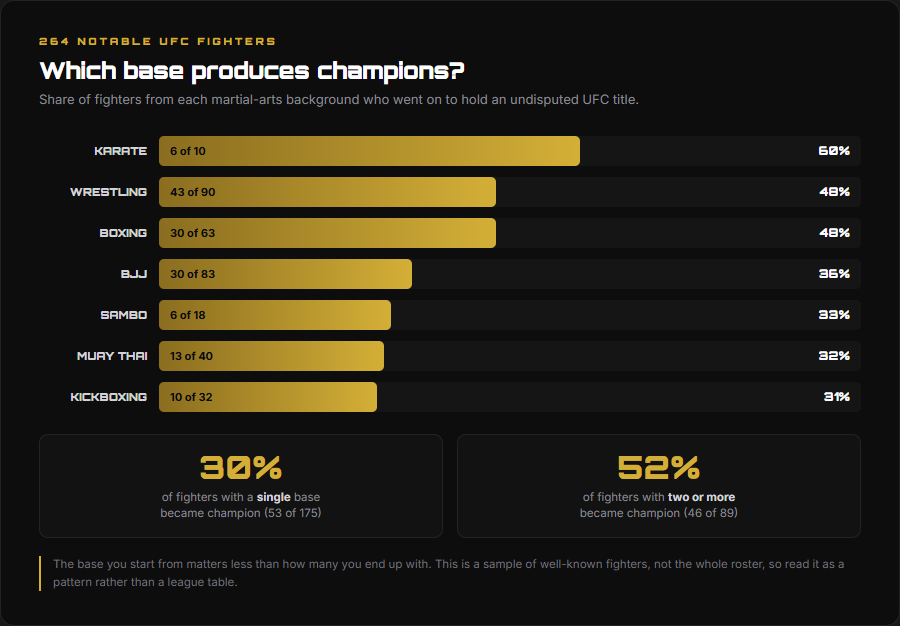
Read that chart carefully, because the obvious conclusion is the wrong one. Yes, wrestlers convert to champions at a higher rate than jiu-jitsu players, 48% against 36%. But the sample sizes are uneven, karate's 60% rests on ten fighters, and none of it controls for the era someone fought in.
The finding that actually holds up is the one at the bottom of the chart:
Fighters with a single martial-arts base became champion 30% of the time. Fighters with two or more did it 52% of the time.
Which reframes the original question. A BJJ black belt is not a weapon you bring to MMA. It is a floor you build so that the fight happens where you want it. It means nobody submits you, nobody holds you down, and every takedown they land is a temporary problem instead of the end of the round. What wins the fight is what you bolt onto that floor.
The clearest illustration is the sport's own history. Royce Gracie won the first UFC as a pure jiu-jitsu practitioner against opponents who had no answer to it at all. That worked exactly once in history, because everyone then went and learned the answer. Today a black belt does not beat the division. It stops the division beating you on the ground, which is not the same claim, but it is a much more durable one.
A note on the numbers. Our 264 are notable fighters, not the full UFC roster, so they skew toward people you have heard of, which skews toward champions. Treat the percentages as a pattern, not a league table. "Base" also means the discipline someone came up through, not the only thing they trained; almost every modern fighter cross-trains everything eventually.
If you are actually thinking about starting
The honest framing is not "how fast can I get the belt." Nobody who finishes gets there by optimising the timeline. They get there by still being on the mats at year nine, which is a completely different problem to solve.
Two things follow from that. Pick a gym you can get to easily, because convenience beats prestige over a decade. And go three times a week for two years before you decide whether you like it, because almost everything that makes jiu-jitsu addictive happens after the point where you stop being completely helpless.
Related reading
If you want more on how grappling actually plays out under MMA rules, we broke down the submissions that end fights and how the main fighting styles match up. There is also a piece on fight IQ, which is the closest thing striking has to the pattern-recognition a black belt builds on the ground.
Or put it to the test: our UFC fight simulator runs any matchup from 300+ real fighters and weighs grappling against striking rather than averaging everything into one number, and MMA Career Simulator lets you raise a fighter from prospect to champion and choose which base to build them on.
Frequently asked questions
How long does it take to get a BJJ black belt?
The IBJJF minimums are 2 years at blue, 18 months at purple and 1 year at brown, so four and a half years from blue belt is the fastest permitted route. In practice most people take around ten to thirteen years, because the minimums assume uninterrupted training and real life rarely cooperates.
What are the BJJ belts in order?
For adults: white, blue, purple, brown, black. Above black there are coral belts (red-and-black, then red-and-white) and finally red, which are awarded for decades of contribution rather than competitive ability. Children and teenagers use a separate belt system.
Can you get a BJJ black belt in 5 years?
It is technically possible if you reach blue quickly and hit every minimum, and a handful of full-time competitive athletes have done it. It is rare enough that it is not a plan. It is an outcome that happens to people already training like professionals.
Does a BJJ black belt help in MMA?
It helps, but not the way people assume. Across 264 notable UFC fighters in our database, 83 came from a BJJ base and 30 became undisputed champions. The stronger pattern is that fighters with two or more martial-arts backgrounds became champions 52% of the time versus 30% for single-base fighters. A black belt is best understood as a floor that stops you losing on the ground, not a weapon that wins fights on its own.
Is there a belt test in BJJ?
Usually not. Most academies promote at the instructor's discretion based on years of watching you train and spar, with no formal exam. Some gyms run their own curriculum tests, but there is no universal one, which is a large part of why timelines vary so much between schools.